About Long Shot
The two-variable problem
Every shot is a choice of angle and speed, and many combinations reach the same target. A high, slow, lofted arrow and a flat, fast one can both land in the gold, but they behave very differently: the lofted shot has a steep descent that makes distance errors obvious, while the flat shot is unforgiving about angle.
The practical consequence is that at moderate range you should shoot flat, and at extreme range you have no choice but to loft. The transition point is roughly where the target stops fitting comfortably in the lower third of the screen.
Reading the arc preview
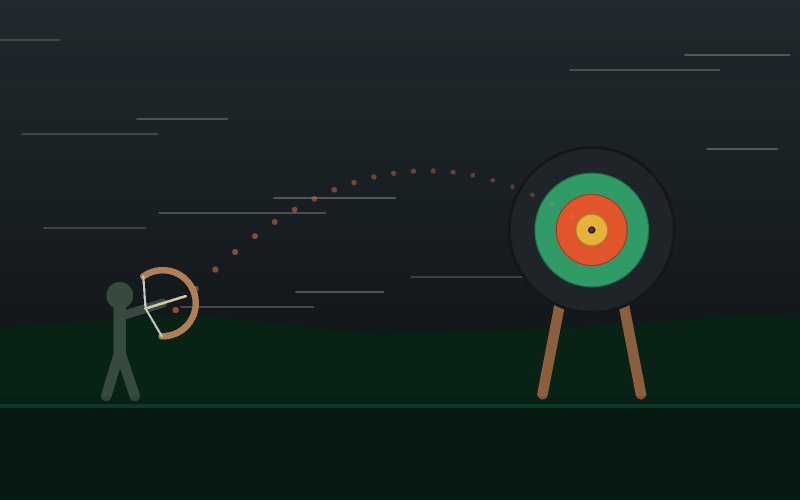
While you drag, a dotted arc shows the predicted path. It runs the same integration the real arrow uses, so it is not an approximation - if the preview lands short, the arrow will land short.
The preview fades out toward its end. That fade is not decoration: it marks the point where small changes in your draw produce large changes in the landing spot, which is exactly where you should be paying attention.
Distance scoring
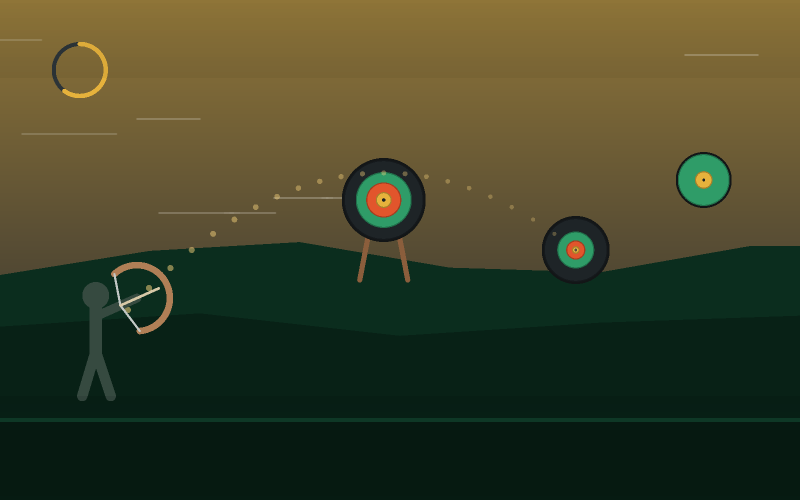
Points scale with range. A target at the near marker pays base value; the far marker pays roughly three times as much for the same ring. Because you only get twelve arrows, the run is largely decided by how many long shots you are willing to attempt.
There is also a distance record tracked separately from the score - the furthest target you have ever hit. Some players chase that instead.
How to play
- Press and drag backwards from the archer to draw.
- The angle of your drag sets the launch angle; the length sets the power.
- Watch the dotted arc to judge where the arrow will land.
- Release to shoot.
- You have twelve arrows.
Controls
| Where | What to do |
|---|---|
| Desktop | Click and drag back to draw, release to shoot |
| Mobile / tablet | Touch and drag back, lift your finger to shoot |
| Pause | Escape or the pause button |
Scoring
Points are awarded by which band of the target you hit, multiplied by your combo multiplier where the game uses one.
Tips
- For distant targets, add angle before you add power - a lofted arrow travels further per unit of draw.
- Around forty five degrees gives maximum range. Beyond that you are trading distance for height.
- Trust the arc preview completely. It uses the same maths as the arrow.
- If a shot lands just short, add a small amount of power rather than changing the angle.
- Bank two or three near targets early so a run of long misses does not end with nothing.
Common mistakes
- Maxing the draw on every shot, which makes the flat trajectory unforgiving.
- Adjusting angle and power at the same time after a miss - change one variable at a time.
- Ignoring the fade at the end of the arc preview.
- Spending all twelve arrows on the furthest target for the distance record and scoring almost nothing.
Features
- Full projectile physics with a draw-to-power bow
- Live trajectory preview using the real integration
- Distance-scaled scoring across five range markers
- Separate longest-hit record
- Twelve arrow runs